Showing posts with label Politics. Show all posts

Saturday, 16 July 2011

French Tragedy ep.3: Military Parade and Underpinning Xenophobia


Eva Joly is the green candidate for the 2012 French presidential election. She was born in Norway and moved to Paris to become an 'au pair' when she was 20. Decades later, after a career as a magistrate (see her Wikipedia page), she was chosen by the Greens to be their candidate for next year's election.

This year, for Bastille Day on the 14th of July, she expressed her dream of getting rid of the traditional army parade happening on the Champ Elysee since 1919 (as far as my knowledge goes). Instead, she would prefer seeing a 'citizen parade', following the model of what they do in Norway. Indeed military parades mostly occur in dictatorships (and Russia) and don't really make sense at the age of a pacified Europe.

As usual, instead of opening a debate about the legitimacy of the military parade for Bastille Day, Joly's proposition rather caused a bunch of foul reactions from politicians among the right, extreme right, but also among the socialist party, the so-called left party that proves everyday that they are closer to liberal-conservatives than to the actual left.

Some deputies have suggested that Joly should go back to Norway, because you know, it is such a terrible thing to say about the military parade, one of France's main institutions. The 'more balanced' ones (including the prime minister's reaction) only said that her knowledge of France's culture is too limited to assert such things. The very popular (but unjustified?) military parade shows in sum the conception of politicians about what being French is: Joly, despite being French and in the country for almost 40 years, is reminded that if she deeply isn't French, and cannot fully understand this country. Besides she has an accent, so how dares she questioning the traditions of the country that has welcome her so gratefully?

Because the best way to preserve the stupid traditions of the country is through a snobby elitist xenophobia...

Sunday, 20 March 2011

We are at war again...


International relations fascinate me. If I had to do something else than sociology, I'd go for international relations. Few months ago, an Italian guy came to Griffith to do a talk about the danger of Iran getting the nuclear bomb. All Griffith students had received an email about that. On the day, in the audience, 3 people... A chick who studied international relations, a Sri Lankian who only arrived and who went to everything he could, and me. It took me 2 minutes to realize that my knowledge in the discipline was bigger than the chick's one... (but that's not the topic of the day, I will probably write an article one day about how apathetic I find Australia).

This picture of Gaddafi (in Europe it's written Kadhafi) and Sarkozy was taken in December 2007, when the French president welcame the Libyan leader for an official visit. All the honors were deployed to receive Gaddafi, as he agreed to set Bulgarian nurses few months earlier (see details > here). Yesterday on the 19th March, Sarkozy who took the lead of a coalition organized a meeting in Paris with British PM Cameron, Hillary Clinton and some others partners (Canadian, Italian...). It has finally been decided that the rebels in Libya would be backed up (these rebels have been calling for help for weeks), now that Gaddafi has counter-attacked and almost reached the North East city of Benghazi.

Between these two moments, revolutions have taken place in North Africa which have given an example to follow for many people undergoing dictatorships. France have backed up murderers in Tunisia (I wrote about it here), and Sarkozy thought that it'd be a good idea to go in war in Libya to make people forget about this, and about the absolutely amazing amount of internal affairs that is transforming the French regime and government into a big joke.

Now we end up with a situation where western countries (minus Germany, but quid about Spain?!) is engaged in a war in Libya against a crazy dictator who would do everything to keep his ass on his seat, and who, if he gets down, will definitely bring everybody he can: he has already threatened to hit military and civilian places in Southern Europe, and is looking for friends in the region in order to globalize the conflict (too bad for him, his two main neighbors got rid of their own dictators). On the other hand, the coalition doesn't look undoubtful: Qatar, who know unrest in their country that they are handling with a huge repression. But by participating, they are assured that 'the leaders of the free world', the 'inventors of Human Rights' won't get involved in their own shit. I'm exhausted of western countries' hypocrisy: they always back up dictators first, because they can make deals with, and when media show how fucked a situation is, they suddenly realize that the same dictators are actually mean and they claim they want to protect freedom etc... Gaddafi on the other hand plays the card of interference (droit d'ingérence en francais)...

I personally don't know whether I am for or against this war. I think wars are always the worst solutions, but in a crazy, extreme world we live in, it can unfortunately become a necessary solution. I certainly dislike when western countries get involved in internal affairs of any other countries for economical reasons or to order them to do anything, but can we let a crazy idiot kill his people to sit his power?

Tuesday, 1 February 2011

After Tunisia, Egypt


Egypt is now following the model set by Tunisia and is in big turmoil.

I watched the special show Anderson Cooper hosted on CNN on Saturday (the 29th of January). The general trend is to support the will of the people, so follow the protesters and ask for an end of the dictatorship. They easily forgot that they (I totally group journalists and governments together here) have supported Mubarak for 30 years.

Moreover I thought the general tone was a bit too confident if not pretentious: again Cooper and few of his guests felt obliged to feel like they're having the perfect model of regime in US, and that at the end, what Egyptians want is the duplicate of the US. As if it were impossible to look at events without cultural judgments.

Then let's imagine that a democracy type of regime is installed in Egypt, and what if the people elect Muslim extremists, what would be the reaction of western countries? To still support the will of people?!

My point is that it is a bit too easy to support a regime in a country and then to condemn it because the people of this country are protesting against it. The versatility of both journalists and governments never cease to surprise me, especially when their only value consists of protecting their interests.

Friday, 14 January 2011

French Tragedy Ep. 2: Support the Murderers

Episode 2 of French Tragedy brings me to talk about Africa again. But this time by focusing on its extreme north and on 2 countries: Tunisia and Algeria.


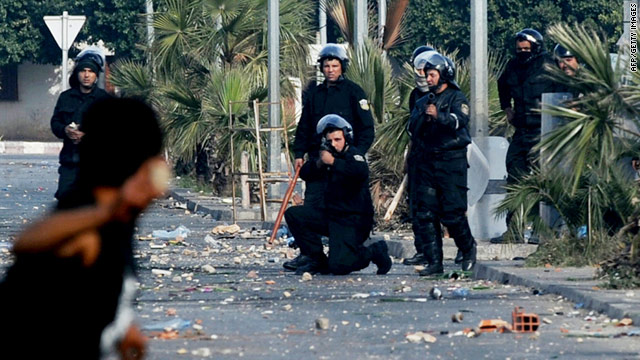
As you know - because you are informed -, there have been riots for days, if not weeks, in both countries. Protesters, especially young people, want the end of dictatorships. Both Tunisia and Algeria are ruled by aged '''presidents''', respectively Ben Ali and Bouteflika, whose reigns are both described as mafia-esque with their own anti-freedom laws. Speculations are aired about the starting of these protests/riots, some even pointing Wikileaks as a potential precursor (see here).

Despite what's going on in both countries, it is also interesting to see how other countries react to the riots. France has really close ties with Tunisia and Algeria which were both French colonies few decades ago and whose independence didn't necessarily happen well (see the Wikipedia article about the war in Algeria here). As I've argued only a few days ago (here), France still likes to interfere in ex-colonies' political and economical matters as much as possible.

The French foreign minister, Michele Alliot Marie, indeed recently offered France's help to maintain security in both countries in a public announcement at the assembly, see the video in French:


ALLIOT-MARIE propose d'aider la Tunisie dans la répression
Uploaded by SuperBeurkMan. - News videos hot off the press.

What I haven't mentioned yet is that Algerian and Tunisian governments have reacted to protests and riots by deliberately shooting in the crowds, killing dozens of people (see here). And the only reaction that the French government has is not only to interfere in the matters of sovereign countries, but also to support governments that are opening fire on their citizens...

Country of the Human Rights they say...

Sunday, 2 January 2011

French Tragedy ep.1: Africa, the Mother Land

The 'French Tragedy' serie will be a recurrent one on this blog... as long as this pathetic country gives me food for that.


On the 2nd of January, I woke up late and both watched BBC World and read some news online. The 'pick of the year' document on BBC touched on the 9/11 and the collapse of the famous tower 7, officially remained unattacked... The online news taught me another older part of the history that is mostly unknown by French people: the war in Cameroon between 1955 and 1962. Everyone rather keeps in the mind the other meanwhile conflict with Algeria, even if I didn't learn much at all about this one in school. All we got told was that the process of decolonization happened more or less in peace after WWII... and few examples were given for the different cases.

The role of France as well was not deeply discussed. Only a few years after I left high school, a law was voted in the parliament by the conservative government about the 'positive aspects of colonization': basically, history books and classes have to argue that colonization was not only about stealing the resources of a whole country (or even half a continent) and treat the populations as being inferior, needing education because they were only savages. Instead, colonization brought infrastructures: roads, schools etc... And in a broader sense, capitalism and globalism.

In the comments of the article about the war in Cameroon, where civilians were slaughtered and tortured (but that was really fashion back in the days... apparently I'm told that it still is!?), I found some comments utilizing the exact same arguments than what the law states, but with the underpinning theory behind it: French people and the French state should not feel sorry and apologize for what happened in the past (aren't you having the similar type of debates about the 'lost generation' in Australia?), and rather be thanked for their contribution of the development of African countries.

And this is where I start feeling sick. Colonization has ONLY been about domination of a powerful country over others in order to state and increase this domination. The infrastructures built only aimed to route natural and primary resources from the lost territories where they seated to their new mother land: France. Still today colonization exists by taking different forms. Yes we conceded their independence but at the specific cost that we can still control what happens in the country: get your freedom, but we will help you with anything only if you still give us what we want. So all dictators around the African continent got some forms of support from France as from other countries, whereas the same kinds of shitheads in other parts of the world have been and are picked on. Vast hypocrisy!

The Ivory Coast's current crisis shows that roles are changing in Africa: while France still aims to empower the political and economical decisions made, China walks in with a different strategy. They don't pretend to care about human rights or democracies like Europe and North America do, they are honest enough to say that it is just about business, and in that game, African countries have more to win with China than with the old aggressive dominant entities. At the end, the results are pathetic for France: the French citizens are not really welcome in those countries, and every comment made about what African countries should do is perceived as a threat.

You can still argue that your shameful actions have had positive effects France, but you've lost this game.

Europe and the Dangerous Drift Towards Authoritarian Regimes

Photo: Viktor Orban, Hungarian prime minister.


Hungary officially took the presidency of the European Union on the 1st of January 2011, according to the 6 months turn-over rule, taking over the leadership of a divided Belgium.

Hungary is also leading Europe towards a worrying fashion. Since the victory of the conservatives few months ago, following 8 years of socialists/labour governance, the country is seeing a wave of new authoritarian laws concerning most noticeably the world of press. According to some forms of obscure commission, journalists who are not being objective in their articles/reportages could be sanctioned and fired. Definitely a model to follow for Berlusconi and Sarkozy.

Blogs are also going to be controlled by the government, as soon as they are being 'edited' and/or produce an income (yes, that's totally fuzzy). The idea is to force bloggers to register into a database from which censorship could apply.

In a country molded by television propaganda/brain washing, the population does not massively react to the threat over their basic freedom. As usual now, internet users lead the protest and consequently share their worries with the rest of Europe by asking two fundamental questions: can such a country lead Europe for 6 months? What is Bruxelles (shortcut to refer to European parliament) doing? Or rather not doing...


Sunday, 22 August 2010

Elections, piège à cons!


So what's happening now Australia?

Too bad you don't have your own Nick Clegg to bend the balance... But copying England cannot last forever anyway!