Friday, 14 January 2011

French Tragedy Ep. 2: Support the Murderers

Episode 2 of French Tragedy brings me to talk about Africa again. But this time by focusing on its extreme north and on 2 countries: Tunisia and Algeria.


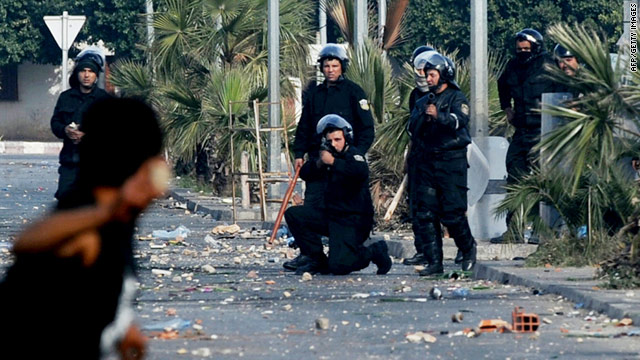
As you know - because you are informed -, there have been riots for days, if not weeks, in both countries. Protesters, especially young people, want the end of dictatorships. Both Tunisia and Algeria are ruled by aged '''presidents''', respectively Ben Ali and Bouteflika, whose reigns are both described as mafia-esque with their own anti-freedom laws. Speculations are aired about the starting of these protests/riots, some even pointing Wikileaks as a potential precursor (see here).

Despite what's going on in both countries, it is also interesting to see how other countries react to the riots. France has really close ties with Tunisia and Algeria which were both French colonies few decades ago and whose independence didn't necessarily happen well (see the Wikipedia article about the war in Algeria here). As I've argued only a few days ago (here), France still likes to interfere in ex-colonies' political and economical matters as much as possible.

The French foreign minister, Michele Alliot Marie, indeed recently offered France's help to maintain security in both countries in a public announcement at the assembly, see the video in French:


ALLIOT-MARIE propose d'aider la Tunisie dans la répression
Uploaded by SuperBeurkMan. - News videos hot off the press.

What I haven't mentioned yet is that Algerian and Tunisian governments have reacted to protests and riots by deliberately shooting in the crowds, killing dozens of people (see here). And the only reaction that the French government has is not only to interfere in the matters of sovereign countries, but also to support governments that are opening fire on their citizens...

Country of the Human Rights they say...

Sunday, 9 January 2011

When Global Warming Brings More Snow in Europe


The snowfall episode which happened the last few weeks in Europe brought its wagon of crappy reactions, the typical kind of reactions stating that an example proves a scientific theory wrong. 'Oh my god, regarding all the snow, there cannot be a global warming, because if temperatures are getting higher, how could there be more snow during winter in Europe?'

Well, if you'd see a bit further than the facts, you'd know that the usual cool temperatures during winter in Europe are caused by a big current in the Atlantic Ocean coming from America and called the 'Gulf Stream'. Indeed, Montreal, where snow is abundant every winter during months, is located on the same latitude than Lyon, where there is rarely snow in winter.

However, Global Warming would cause the progressive disappearance of the Gulf Stream, making winter colder and bringing more snow.

Two conclusions come to my mind: first, it would be a good idea for European countries to get prepared of having loads of snow in winter, and therefore to stop looking ridiculous and force people to sleep in airports. Second, I tend to believe in a Global Warming caused or reinforced by human activities, however I wouldn't automatically conclude that a particular climatic episode confirms or contradicts the theory...


PS: that should mean more snowy Christmas in Europe in the future... and Christmas is actually Christmas if there is snow involved!

Sunday, 2 January 2011

French Tragedy ep.1: Africa, the Mother Land

The 'French Tragedy' serie will be a recurrent one on this blog... as long as this pathetic country gives me food for that.


On the 2nd of January, I woke up late and both watched BBC World and read some news online. The 'pick of the year' document on BBC touched on the 9/11 and the collapse of the famous tower 7, officially remained unattacked... The online news taught me another older part of the history that is mostly unknown by French people: the war in Cameroon between 1955 and 1962. Everyone rather keeps in the mind the other meanwhile conflict with Algeria, even if I didn't learn much at all about this one in school. All we got told was that the process of decolonization happened more or less in peace after WWII... and few examples were given for the different cases.

The role of France as well was not deeply discussed. Only a few years after I left high school, a law was voted in the parliament by the conservative government about the 'positive aspects of colonization': basically, history books and classes have to argue that colonization was not only about stealing the resources of a whole country (or even half a continent) and treat the populations as being inferior, needing education because they were only savages. Instead, colonization brought infrastructures: roads, schools etc... And in a broader sense, capitalism and globalism.

In the comments of the article about the war in Cameroon, where civilians were slaughtered and tortured (but that was really fashion back in the days... apparently I'm told that it still is!?), I found some comments utilizing the exact same arguments than what the law states, but with the underpinning theory behind it: French people and the French state should not feel sorry and apologize for what happened in the past (aren't you having the similar type of debates about the 'lost generation' in Australia?), and rather be thanked for their contribution of the development of African countries.

And this is where I start feeling sick. Colonization has ONLY been about domination of a powerful country over others in order to state and increase this domination. The infrastructures built only aimed to route natural and primary resources from the lost territories where they seated to their new mother land: France. Still today colonization exists by taking different forms. Yes we conceded their independence but at the specific cost that we can still control what happens in the country: get your freedom, but we will help you with anything only if you still give us what we want. So all dictators around the African continent got some forms of support from France as from other countries, whereas the same kinds of shitheads in other parts of the world have been and are picked on. Vast hypocrisy!

The Ivory Coast's current crisis shows that roles are changing in Africa: while France still aims to empower the political and economical decisions made, China walks in with a different strategy. They don't pretend to care about human rights or democracies like Europe and North America do, they are honest enough to say that it is just about business, and in that game, African countries have more to win with China than with the old aggressive dominant entities. At the end, the results are pathetic for France: the French citizens are not really welcome in those countries, and every comment made about what African countries should do is perceived as a threat.

You can still argue that your shameful actions have had positive effects France, but you've lost this game.

Europe and the Dangerous Drift Towards Authoritarian Regimes

Photo: Viktor Orban, Hungarian prime minister.


Hungary officially took the presidency of the European Union on the 1st of January 2011, according to the 6 months turn-over rule, taking over the leadership of a divided Belgium.

Hungary is also leading Europe towards a worrying fashion. Since the victory of the conservatives few months ago, following 8 years of socialists/labour governance, the country is seeing a wave of new authoritarian laws concerning most noticeably the world of press. According to some forms of obscure commission, journalists who are not being objective in their articles/reportages could be sanctioned and fired. Definitely a model to follow for Berlusconi and Sarkozy.

Blogs are also going to be controlled by the government, as soon as they are being 'edited' and/or produce an income (yes, that's totally fuzzy). The idea is to force bloggers to register into a database from which censorship could apply.

In a country molded by television propaganda/brain washing, the population does not massively react to the threat over their basic freedom. As usual now, internet users lead the protest and consequently share their worries with the rest of Europe by asking two fundamental questions: can such a country lead Europe for 6 months? What is Bruxelles (shortcut to refer to European parliament) doing? Or rather not doing...